
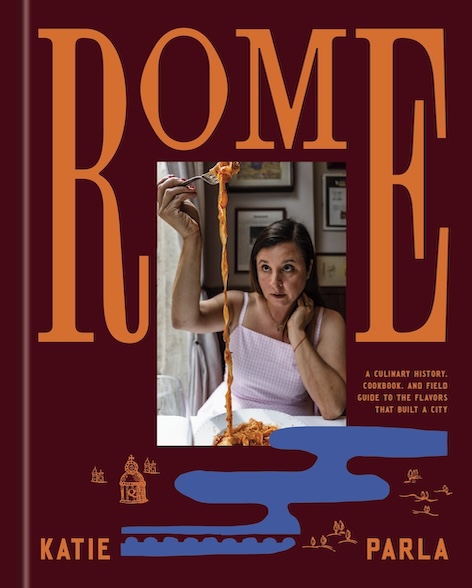
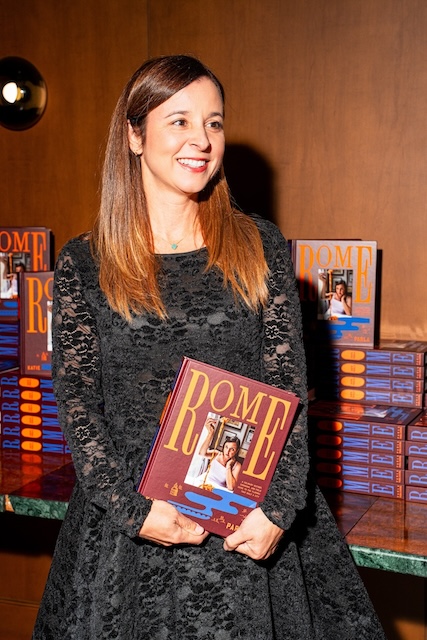
 The bio at the back of her latest book ROME: A culinary history, cookbook, and field guide to the flavors that built a city says: “Katie Parla is a New York Times bestselling author, publisher and podcast host, journalist, culinary guide, and educator based in Rome. Trained as an art historian with a master’s degree in Italian gastronomic culture, she has spent over two decades researching, writing, and teaching about the city’s food and beverage traditions. Kate has written, edited or contributed to more than 40 books, including American Sfoglino, Flour Lab, Food of the Italian South, Tasting Rome, Food of the Italian Islands, and The Joy of Pizza.
In 2002, Katie founded Parla Publishing, independently releasing Food of the Italian Islands, while establishing services to demystify the publishing process for other authors, restaurants, and brands. She also runs Parla Tours, a company offering in-depth private tours and experiences in Rome, Naples, and Venice.
Katie co-hosts Gola, a podcast about Italian food and drinks culture, and has appeared as an expert on television programs including “Stanley Tucci: Searching for Italy” and Netflix’s”Chef’s Table”. She also hosts culinary shows on Recipe.tv, among them her Emmy-nominated food and travel series “Katie Parla’s Rome” as well as “Katie Parla’s Roman Kitchen” and “Gola on the Road”. Her writing has appeared in publications such as The New York Times, Eater, and Saveur, and she is. A regular voice on food culture in Italy both for print and broadcast media.
Our tastes in food are closely connected to our childhood; your first memories of food?
My first memories of food are my uncle daring me to eat fish eyes and cheeks and I would get paid a dollar for every weird thing I ate. That’s how I knew I could earn a living working in food somehow.
Did your family work in food?
Yes, they did. My parents first met at a restaurant where they were both working, and later my Dad had a restaurant of his own until the pandemic. It was a wild game restaurant, if you can believe that, a speakeasy cocktail bar in the front and a wild game fine-dining restaurant in the back.
So wild boar and venison?
Absolutely. Elk, even rattlesnakes. Yeah, all sorts of fun things. A lot came from Long Island and Texas.
Judging from your last name, you must be Italian-American; where did your ancestors come from?
My Mom’s side is half Sicilian and half Lucanian, and my Dad’s side is half Sicilian and half Polish.
Did you come to Italy as a child?
Just with my Latin class. My Mom worked really hard to send me here on a bus tour with my Latin class in 1996, and so that was it for me.
You studied art history at Yale; did you come to Italy to study art?
Yes, I thought I was going to do my master’s and my PhD in ancient Roman architecture and funerary art, but I got very side-tracked by wine and food instead and did my master’s in eno-gastronomy here in Rome.
Why Rome?
I had an instantaneous attraction to Rome. Do you remember Fiumicino airport in the 1990s, definitely not the cutest, but I landed and thought to myself, ‘This is the coolest place in the world.’ I don’t know why, maybe the Roman air.
How did you move from art history to travel and food?
As I just told you, my Dad had a restaurant, which cured me of wanting to own a restaurant. When I first moved here, I began to work in food; I did my sommelier certification; I did my masters in food history, so I thought I how can I work in food without having a business, like a traditional restaurant? I’d already been writing about travel; I’d already been writing about history, so I started to write about food, and slowly that overtook all my other projects.
Did you have a mentor and, if so, what did you learn from him or her?
There’s a woman in Rome I always admired and always looked up to. I wouldn’t call her a mentor per se, but Maureen Fant, a distinguished author of books on the history of Italian food, is someone whom I aspired to be. She also gives food tours of Rome like me.
You have written many cookbooks; do you like to cook?
I like to cook, but I don’t love to cook. I love to eat; I love to be in enoteche, pizzerie, trattorie. I love the experience of hospitality and dining. I love to shop for food. I’ll fill the fridge all day long. I especially love Rome and Roman food culture. I’d write ten more books about Rome if I thought anyone would find them novel enough to read. For me, Rome is everything.
Again, like Maureen, you give food tours. How can your potential clients contact you?
By clicking on www.katieparla.com.
Tell me about your food tours? Where do you go?
My tours are personalized. By that I mean that as soon as I meet my clients in person, we clarify their hopes, wants, and priorities. My tours are limited to six people. Six hours in Naples or three hours in a Roman neighborhood is a very short time. They can choose their tour from the menu on my site. In Rome, they almost always choose a neighborhood walking tour in Testaccio, Trionfale, or the historic center.
So each tour is different based on personal taste?
Yes. I offer tours of Rome, Naples, and Venice. As for Naples, we leave on the 9 AM train and catch an evening train back. So, it’s brief and intense, but it’s a way of promoting Naples to clients who don’t want to spend the night there. They choose Naples to learn all about pizza, so we go straight to the Sanità neighborhood to Isabella de Cham, who specializes in fried pizza, to learn her techniques. We also go to the bakery “Panificio Coppola”, where we learn about how to make traditional bread and pizza dough, and “Da Attilio” at the market in the Pignasecca neighborhood for a tasting. We avoid the famous pizzaioli like those at “Da Michele” or “Sorbillo” because they’ve become world-renowned and are no longer typically Neapolitan.
My Venice tours are on Friday. We start at the fish market at the Rialto because then we go to “bacheri” or wine bars where they go for “cicchetti”, the Venetian equivalent of tapas, for example, “Al Mercà” and “All’Arco”. Our other stop is the neighborhood of Cannaregio, which is full of “bacheri”. My favorite is “Anice Stellato”.
Which of your tours is the most popular? The Roman ones, especially the ones in Prati and Trionfale because my clients want to have the experience of a lively market. We also go to “Panificio Bonci”, “Fischio”, Eroi della Pizza”. Trionfale is a neighborhood of authentic Romans, where artisans still work. Even if Naples is better-known for its pizza in Rome we have a much wider choice of types of pizza: pizzette or bite-size, pizza a sfoglia, pizza tondo, pizzette lievitate, pizza a taglio, pizza a palla, pizza in teglia, so in Trionfale we can go into detail about all the types of pizza.
How many guides collaborate with you?
Eight or nine.
Italian food is well-known worldwide, but what do your clients dream of tasting while they are here?
On the social networks, they talk about Rome’s four typical pasta dishes: carbonara, cacio e pepe, matriciana, and griscia, so it’s my job to inform my clients that Rome offers many other local pasta dishes than these four. “OK,” I tell them, “You can go to a trattoria and eat these four, but unless you order fettucine con le rigaglie, rigatoni con la pajata, trippa, gnocchi with oxtail sauce, you haven’t eaten in Rome.” I don’t take them to a trattoria; there’s not time on a 3-hour tour, but I tell them where to go.
Obviously, in Naples they dream about eating pizza, but I also have them take mozzarella made with water buffalo milk and fried dishes. In Rome, they want to taste tripe, oxtail, and innards because in the United States, at least, you can’t buy these ingredients.
You mean they want to eat quinto quarto?
Yes, and also horse meat, best prepared at the market in Testaccio and at “Osteria Bonelli” in the outskirt neighborhood of Tor Pignatara.
Are most of your clients Italian-Americans?
Americans, yes, but not necessarily Italian-Americans, Australians, Brits, and other English-speaking nationalities like Israelis and Northern Europeans.
You’ve written several books about Rome, its cuisine, and its restaurants. Can you list seven restaurants where you tell your clients they must go?
Especially “Cesare al Casaletto”, a trattoria of a different era, almost nostalgic, “Tavernaccio da Bruno”, another historic place near the station in Trastevere; “Piatto Romano” in Testaccio; “Santo Palato” near St. John in Lateran; “Trecca”, and if they want to eat in the center “Grappolo D’Oro” and “Armando al Pantheon”. All these places invest heavily in the best local ingredients.
In Naples? “Da Attilio”, “Causeari Cautero”, “Isabella de Cham”; “Paneficio Coppola”, “Friggitori Vomero”; and “Antica Salumeria Malinconico”. In Venice? “Anice Stellato”, “Vini da Gigio”, “Alle Testiere”, “AcquaStanca on Murano, “La Maddalena” at Mazzorbo, “All’Arco” and “Al Mercá” at the Rialto.
In Italy’s other big cities, where you don’t offer tours, what other markets should tourists visit?
In Florence the Mercato Centrale, which dates to the 19th century, in Turin, Porta Palazzo; and in Catania, the fish market.
What do you like best about your work?
I love building relationships with people in the food industry and my daily life is filled with people who I buy artichokes from or from whom I learn pizza-making techniques, or who buy incredible wines for their trattoria, and I love sharing what I know and what I learn about with other people.
The least?
I hate that I have do this sharing on social media, and not just in books and articles. Social media is exhausting and soul-crushing. I wish I didn’t have to be on Instagram all the time.
What are your favorite foods?
Pizza, pizza, and more pizza al taglio. I love potato pizza and pizza rossa so intensely. I eat pizza rossa for breakfast every single day.
Favorite wines?
I do really love the Cesanese-based wines of Latium for sure, but I think honestly that my favorite wines are white wines from Friuli and Mount Etna.
A dish you dislike?
That’s a great question. I don’t love tiramisù. I could live without it. Is that a hot take?
Your favorite restaurants?
I love “Cesare al Casaletto” and go there at least every other week. “Armando al Pantheon” is a place I’ve been going to since I moved here. I would save for at least two months to go eat there in 2003, and I have always connected with the Gargioli family, very special people. I also love “Santo Palato” near St. John in Lateran, which is also a little bit more of a modern approach to Roman and central Italian dishes. The chef there is from the Abruzzo, so he cooks a lot of lamb, which I love.
Your feelings about food critics and restaurant guides?
They are commerce; they are businesses. They are steeped in marketing. Journalism, especially in the food and travel sector, has to rely on kickbacks and freebies. That’s just how a food and travel writer needs to survive. I don’t particularly subscribe to that, but then I’ve always had three jobs that have helped to fund my writing. So I can afford to say no to invites because I have other sources of support: a tour company, editorial consultancy, a publishing company, and business consultancy for food companies and restaurants, like writing advertising blurbs and manuals, and making videos.
You have just published Rome: A Culinary History, Cookbook, and Field Guide to the Flavors That Built a City. Are you working on another project?
An abridged version of my latest book, a pocket version with a paperback cover, aimed not only for visitors to Rome, but useful for residents as well. It will include where to shop for food, not only where to eat.