
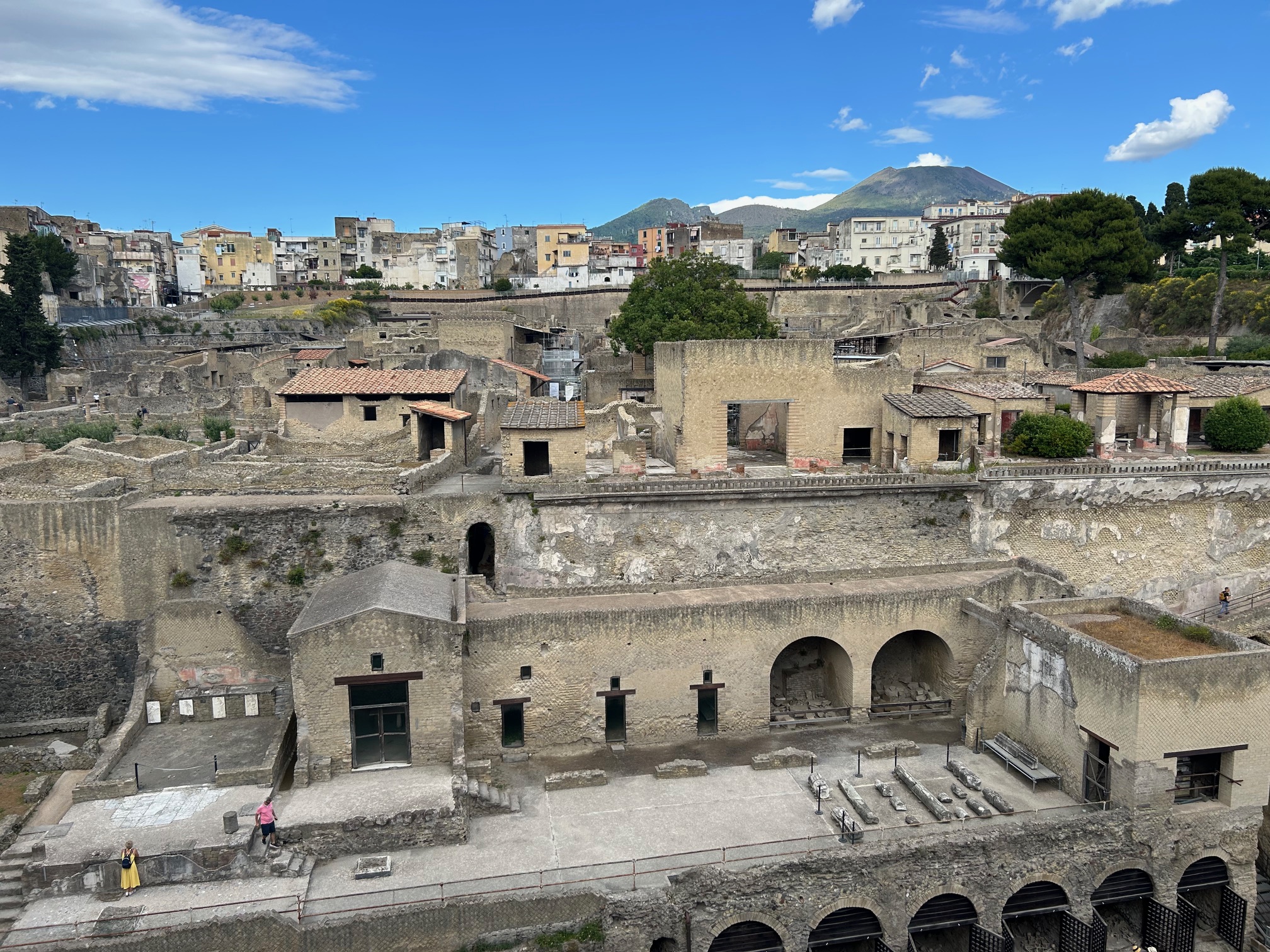
A view of ancient Herculaneum photo credit: Lucy Gordan
The only eyewitness account of the two-day eruption of Mount Vesuvius in 79 AD handed down to us are two letters written by Pliny the Younger, a Roman lawyer, magistrate and author and sent to the historian Tacitus some 25 years after the disaster. Today their surviving six pages are conserved in the Morgan Library in New York City.
Pliny describes how on the first day molten ash buried Pompei under some 20 feet collapsing most of its buildings under its weight and killing at least 2,000 of its 15,000 inhabitants by suffocation. Instead, the first day very little ash fell on Herculaneum, allowing almost all of its 5,000 inhabitants to escape before the town was buried under 66 feet of lava which flowed down the mountainside in six successive surges on the second day. During these two days the explosions released 100,000 times the thermal energy of the atomic bombings of Hiroshima and Nagasaki.
It seems that only some 350 people died carbonized at Herculaneum and, that once the lava solidified, this rich town, a seaside retreat for the Roman elite, was preserved charred, but nearly intact, sealed without oxygen, sort of like sous vide. Proof of this is that many wooden objects such as roofs, beds, and doors as well as other organic-based materials, such as food and papyrus, have also been preserved. Moreover, because of the hardness of the lava and continued construction on site even today, only a fraction of Herculaneum has been excavated.
For many centuries it was believed the Mount Vesuvius erupted during the summer. However, recent excavation and research have shown that the eruption took place on or after October 17 for several reasons. The Pompeians buried under ash were wearing heavier clothing than their light summer clothes. Coins found there in the purse of a woman buried under ash include one with a 15th imperatorial acclamation among the Emperor Titus’s titles and could not have been minted before the second week of September. Not to omit that wine fermenting jars found at both archeological sites had been sealed, which would have happened around the end of October; that the fresh fruits and vegetables excavated in the shops are typical of October and conversely the fruits typical of August were already were already being sold in dried or conserved form.
On in Herculaneum until December 31 at the magnificently frescoed 18th-century Rococo Villa Campolieto designed by the Neapolitan architect and painter Luigi Vanvitelli (1700-1773) located on Herculaneum’s “Golden Mile” is the small but extraordinary exhibition, “From Eggs to Apples: The Culture of Food and the Pleasures of the Table in Ancient Herculaneum”, curated by the director Herculaneum’s excavations Francesco Sirano and the archeologist Mariacarmen Pepe. It gets its title from a proverb: “ab ovo usque ad mala” by the ancient Roman poet Horace, who was alluding to the Roman tradition of starting a meal with eggs and finishing it with apples: thus, all-inclusive or from start to finish.
The first exhibition ever entirely devoted to ancient “Roman” food, Ab ovo usque ad mala is the third and final exhibition about the finds of Herculaneum. The first in 2018, “SplendOri. Il lusso negli ornamenti a Ercolano” concerned the valuable artifacts: jewellery: necklaces, rings, earrings, coins and precious oil lamps and was displayed in the Site’s Museum, where they remain today. The second, “Materia”. Il legno che non bruciò a Ercolano”( “Materials: The Woods that Didn’t Burn up at Herculaneum”), now also on display in the Site’s Museum, concerned wooden, cloth, and other organic objects like food, preserved in tact because of lack of oxygen. On display were furniture, frames, architraves, doors, one of which is a unique folding one, and a boat. This present exhibition aims to feature kitchen utensils and the large amount and variety of food emphasizing the high quality of these finds at Herculaneum, thus the foods, their preparation, and the table ware.
Exhibition logo photo credit: Ufficio Stampa Ercolano
The first section of “From Eggs to Apples”, “Daily Bread” concerns ancient Herculaneum’s most important food, bread, still today’s most important food worldwide. The bread displayed here was made with many different grains: spelt, millet, barley, and wheat for examples, and in many different forms as it still is today: in round loaves or flat like today’s pizza, usually eaten by the poor, or biscuits, sometimes decorated and often sold in thermopolia or fast-food street stalls.
At first the grains were home-ground, often coarsely, in millstones and home-baked. Sometimes the dough of the round loaves had incisions (usually eight) to facilitate slicing after baking. Later bakeries produced both bread and cakes; some even baked their clients’ bread, the dough being initialized for later ownership recognition, a practice still not uncommon in southern Italy. In addition to carbonized grains and bread on display here are millstones, primitive hand-turned mixers for home baking and later more sophisticated professional ones, brick and tile dome-shaped ovens, and bronze or terracotta, often round, baking dishes and trays. Needless to say, many of these baking utensils are similar to today’s.
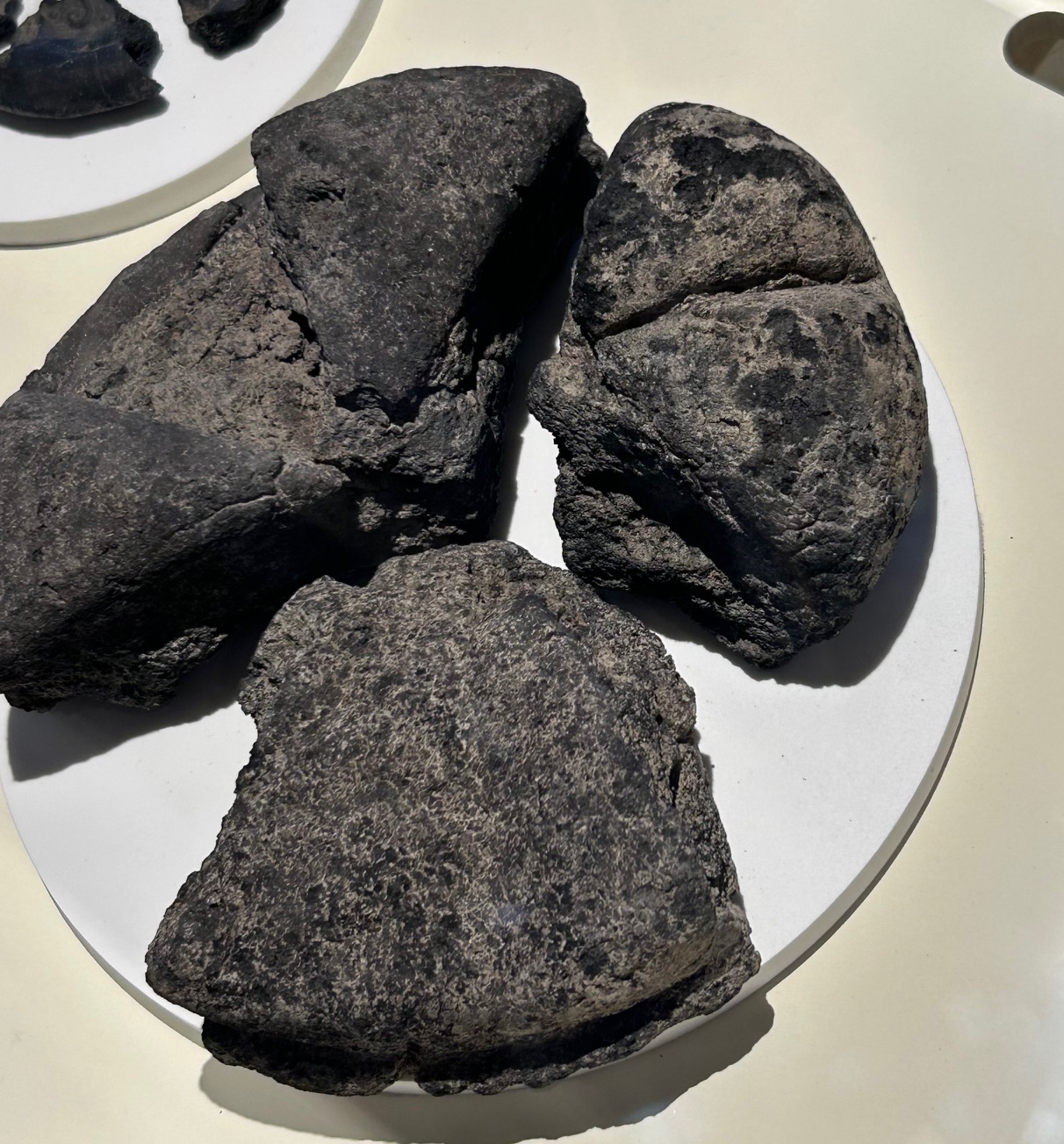
Carbonized Bread photo credit: Lucy Gordan
On display in the second section, “Not to Bake, to Cook” are legumes: lentils, chickpeas, dried peas as well as spelt, the common ingredients for thick soups, very popular nourishment in Herculaneum during the autumn and winter, as well as numerous terracotta pots. Also here are several iron spits and grills for cooking fish and meats, usually chicken, pork, rabbit or lamb as well bronze utensils.
The highlights of this section are four: a bronze boiler filled with water, fitted with a perforated cover to allow for vapor and omnipresent on a stove so there would always be hot water available to add to “slow-cooking” dishes like soups and meats; a large decorated bronze “barrel” or cista also filled with water for household use not only in the kitchen; a multi-shelved wooden cupboard, excavated from a store, still containing amphoras full of olive oil and wines, sacks of flour, onions, dried vegetables, pinenuts, olives, dates from Egypt, terracotta or glass jars of honey and valuable spices: black pepper and cumin from India; and a section of a septic tank containing human waste from the latrines often next to the kitchen as well as culinary discards like fruit seeds and pits, egg shells, meat bones, fishbones, crustacean shells, and broken pots, dishes, and glassware.
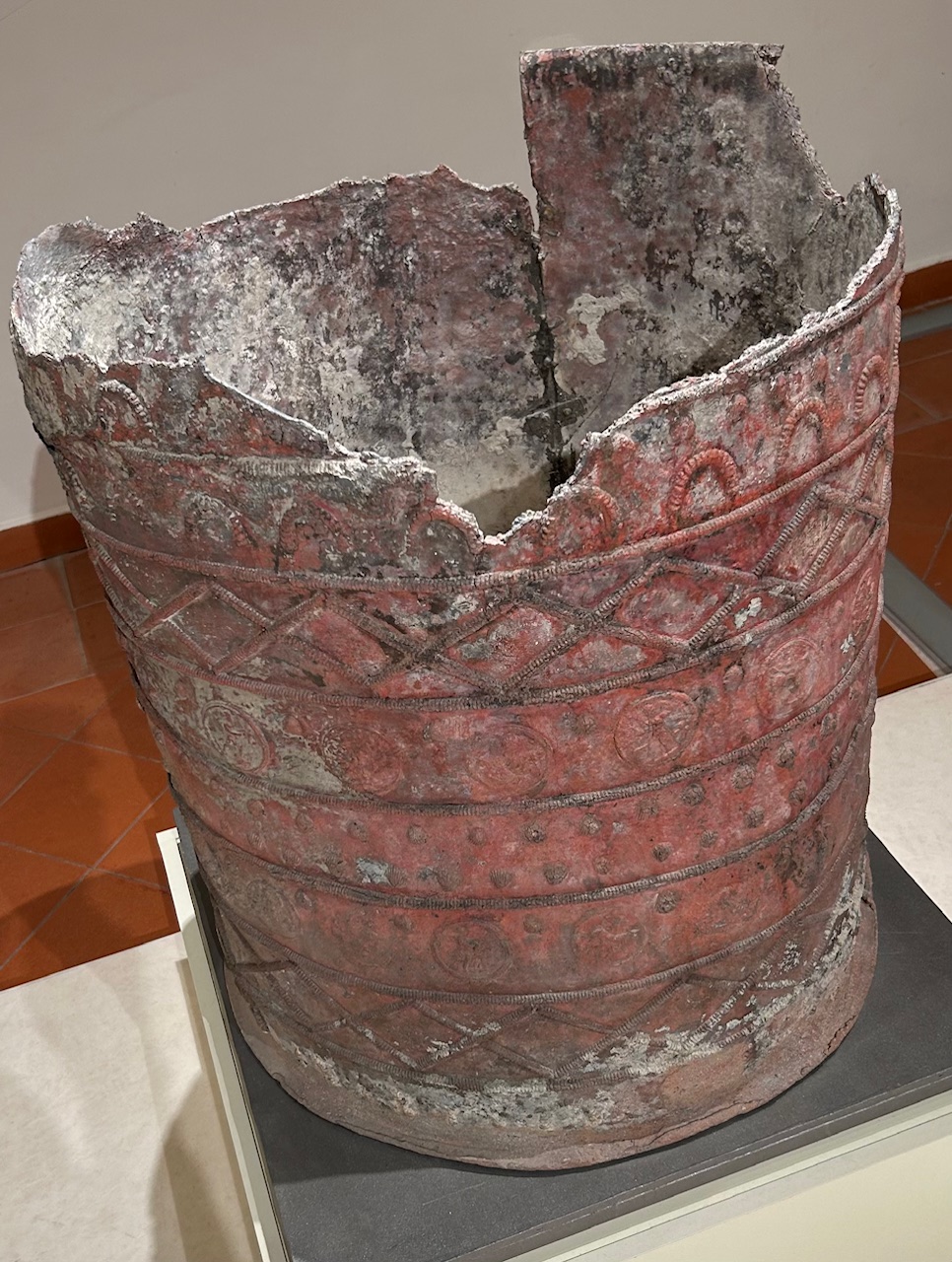
Cista photo credit: Lucy Gordan
The highlights of “Shopping List” are two frescoes on loan from National Museum of Archeology in Naples: one of mullets and shellfish and the other of amphoras labelled with the local wines for sale, hand-held scales, coins, and a locellus or wallet made of wood, bronze and silver probably dropped by its owner in flight.
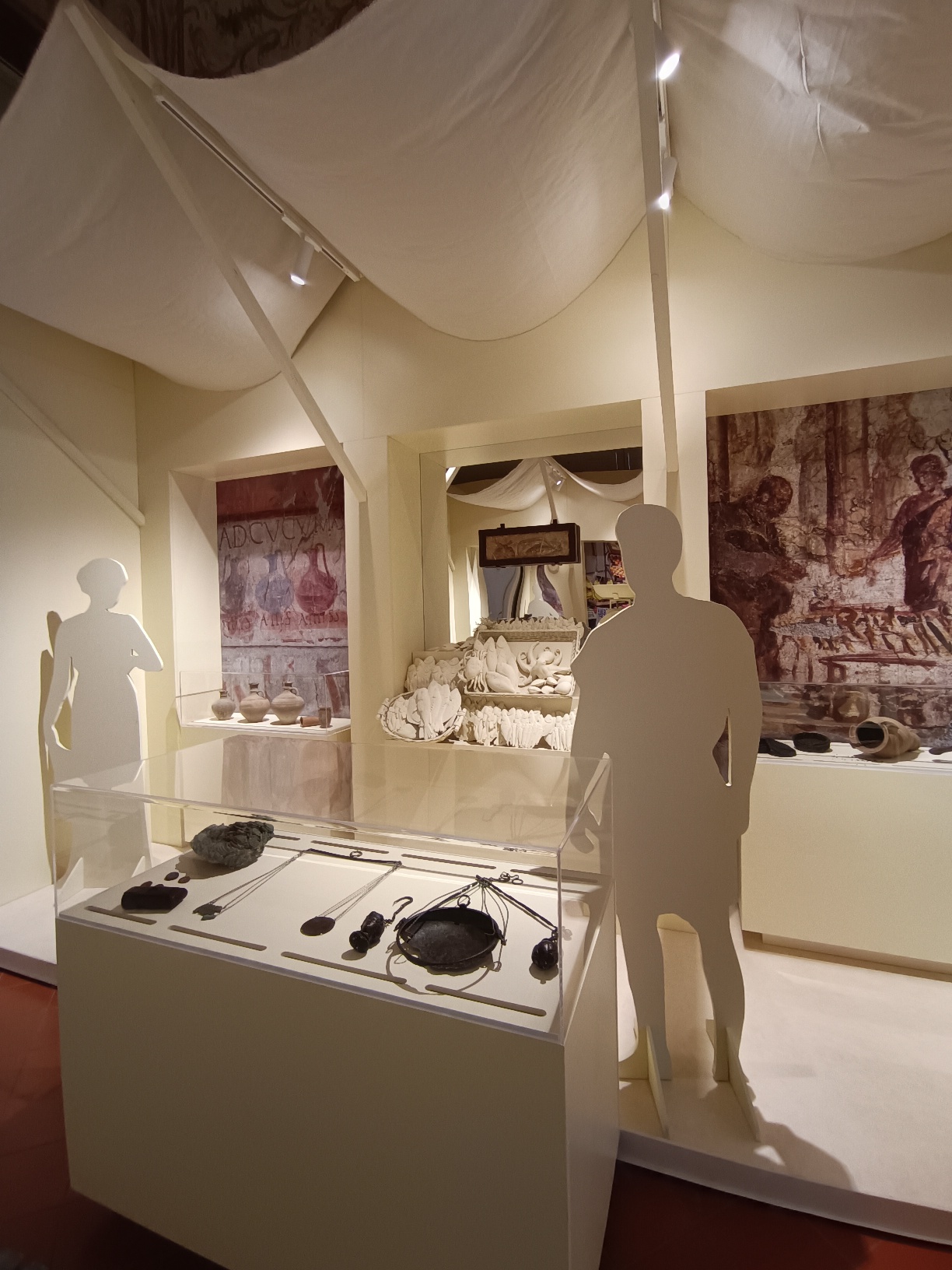
“Shopping List” photo credit: Ufficio Stampa Ercolano
Those in “From Breakfast to Dinner” are the different tableware and foods at the three daily meals: Ientaculum, Prandium, and Coena and a larva convivialis. It’s a banquet’s decoration at the center of each table of a miniature silver skeleton to remind the guests, usually both men and women together, that life is short and to enjoy its pleasures, in short carpe diem.
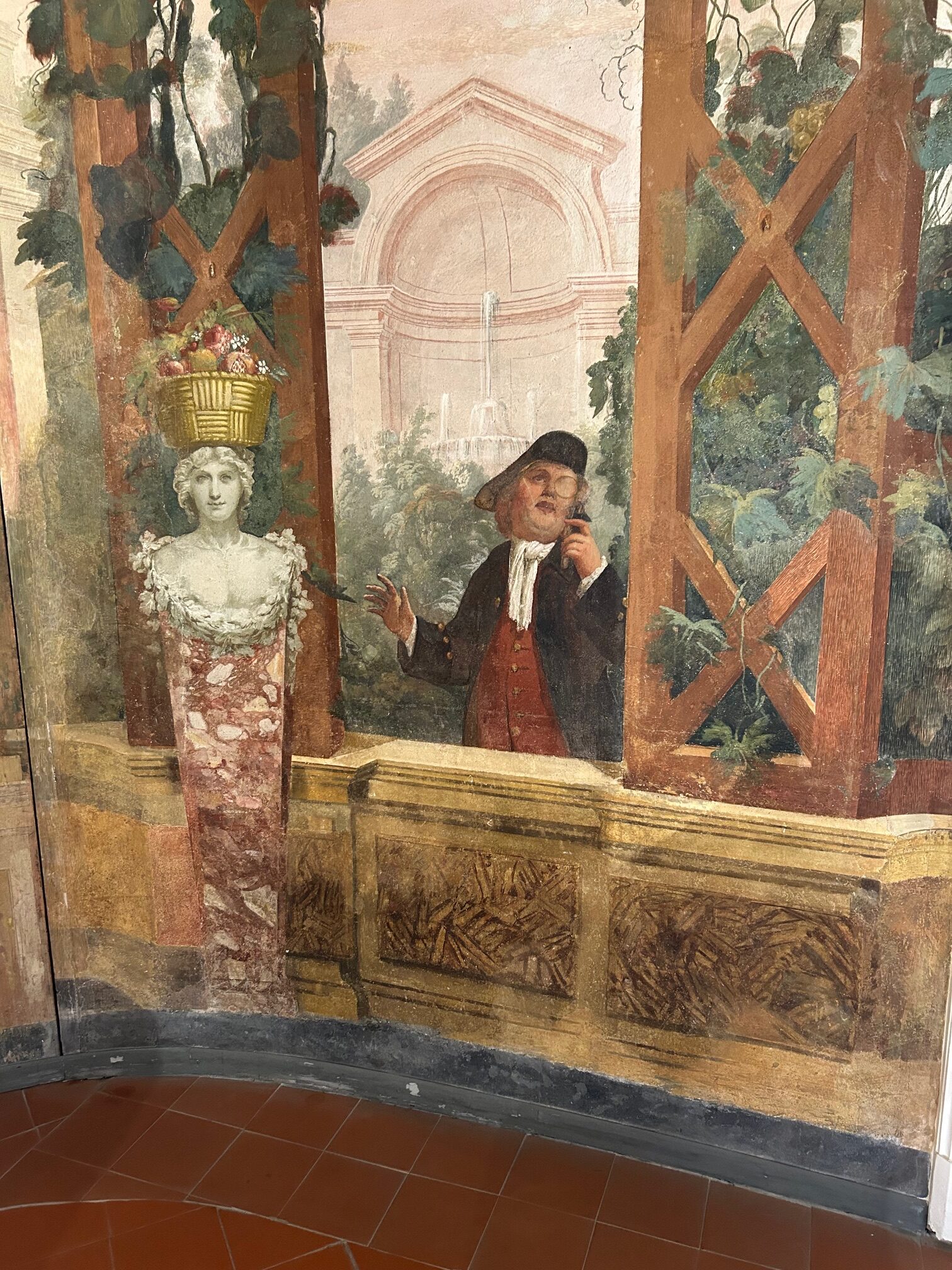
Vanvitelli’s sef-portrait photo credit: Lucy Gordan
Ientculum or breakfast was eaten between 8 and 9 AM. For the poor it was frugal: a glass of goat’s milk or of aromatic water accompanied by bread dipped in wine or in a garlic sauce. The better-off enriched their breakfast with dried fruits, olives, cheese, eggs, and sometimes meat. Consumed between noon and 2 PM, prandium was eaten quickly and often served cold. Most people ate it away from home in taverns or popinae, a kind of fast-food usually at street corners. Their menus included, soups, vegetables, fish, pork, mushrooms, and cheese, and of course, local wine. Some had benches, but most clients ate standing up.
Coena, which began at around 4 PM was the main meal of the day. For the poor it ended at sundown, but for the rich it ended far into the night. The homes of the rich had a triclinium (dining room) lit after dark with candelabra and lucernae or oil lamps, where everyone ate reclining on “couches”. The coena began with antipasti (gustatio): eggs, olives, shellfish in spicy sauces and accompanied by mulsum, wine sweetened by honey. The main dishes (primae mensae) included a choice of elaborate roasts, spicy meatballs, and cakes of fried anchovies. Secundae mensae or desserts were a combination of fresh seasonal fruits, dried fruits like figs or dates, and honey-sweetened cakes.
Epilogue: After my tour with Director Sirano and archaeologist Pepe, Sirano provided me with additional information about the eating habits and health issues of the Ercolanesi. He told me that the tableware found at Herculaneum was less valuable that excavated at Pompei because it been taken elsewhere during the earthquake of 62 AD or even during the day before the lava eruption.
As for the foods, Sirano told me that “we know that bread, fish, and pork were available to all classes whereas red meat was only for the elite. The rich also are dormice and ostrich which we no longer eat.”
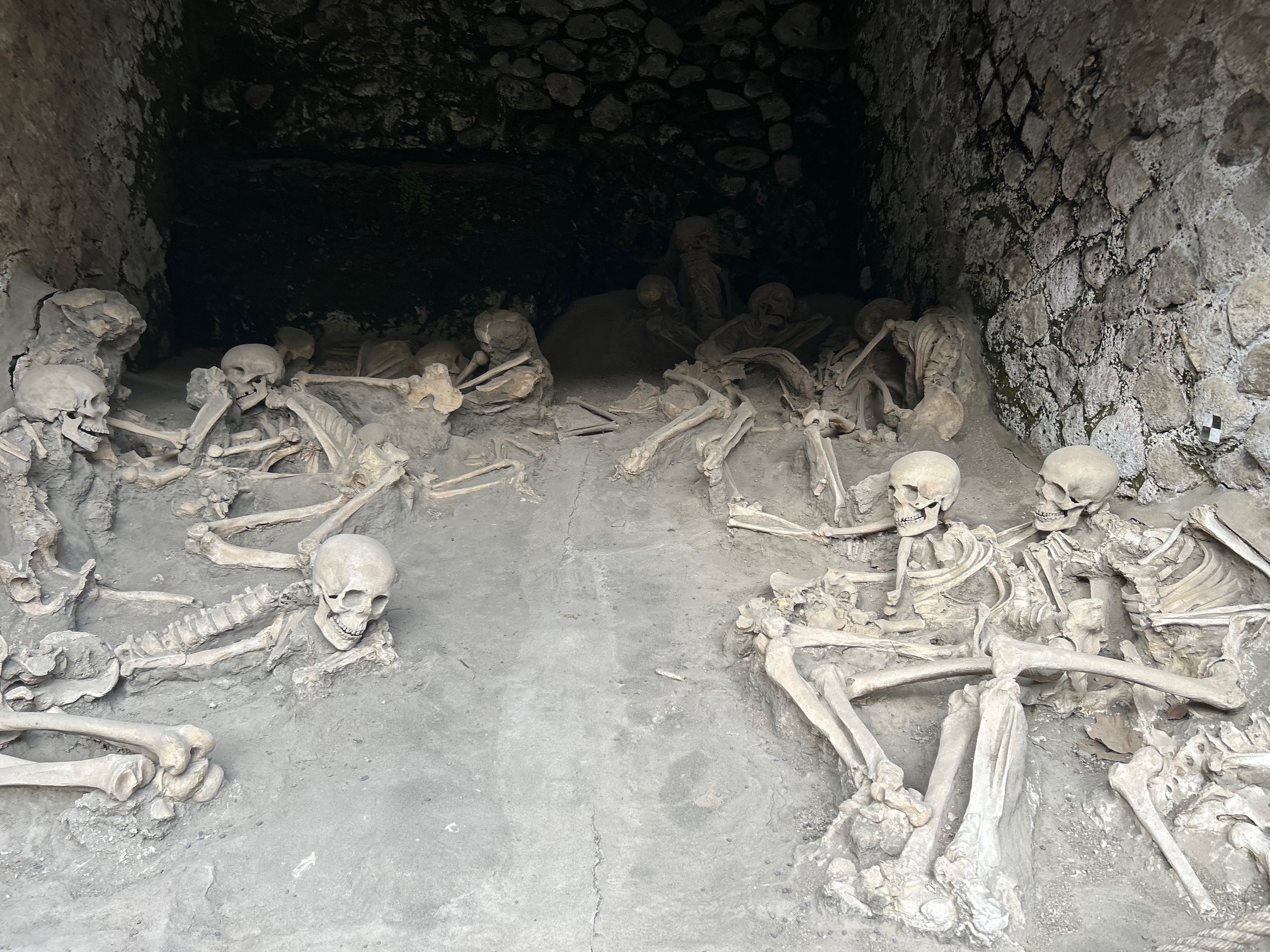
Skeletons in a boat house photo credit: Lucy Gordan
“A lot of what we know about diet”, he continued, “comes from the 340 skeletons found between 1980 and 2000, but mostly during the 1990s. The skeletons of women and children were found in “boat houses”, while those of men on the beach. One of these belongs to a military officer (with an elaborate dagger and belt) so perhaps he had arrived as a member of a rescue mission.”
“Stable isotope analysis of bone samples of 17 individuals (11 men and 6 women) revealed,” Sirano explained, “that the men ate 1.6 times more fish than women, who consumed more meat, eggs, and dairy products. Tooth decay was prevalent because of the large amount of carbohydrates in their diets as was brucellosis, a bacteria found in unpasteurized milk so also in cheese. From this analysis we also know what diseases and broken bones the skeletons had before the eruption and those incurred at death. It is still possible to see many of the skeletons still in the “boat houses” at Herculaneum’s Archeological Park.”
Two words of advice: Herculaneum’s Archeological Park is on several levels, so a steep descent to the “boat houses” and a strenuous climb up. There is no elevator. So be sure to wear comfortable and supportive shoes. After your visit to the Park and “From Eggs to Apples”, enjoy Herculaneum’s wide choice of modern specialties at Viva Lo Re, only a few doors away from Villa Campolieto.