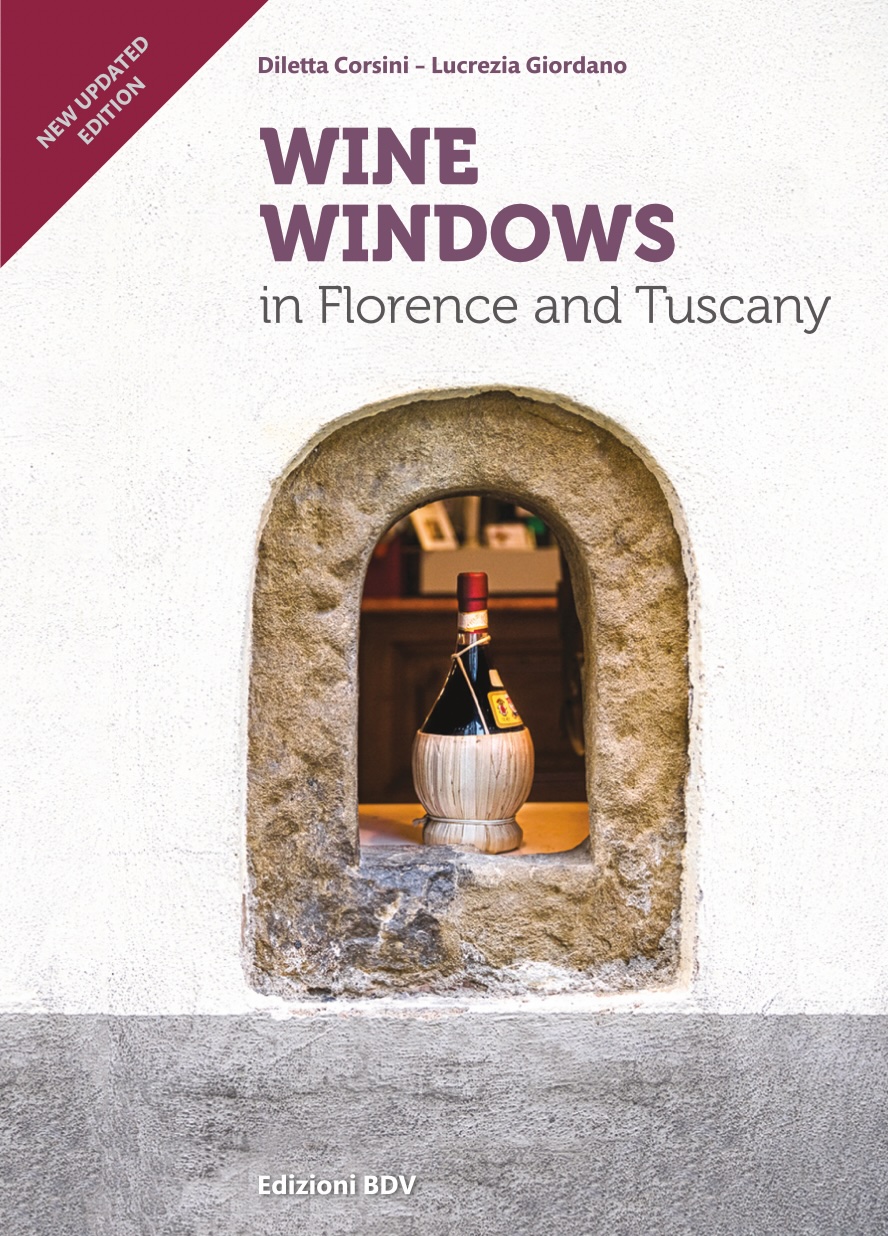
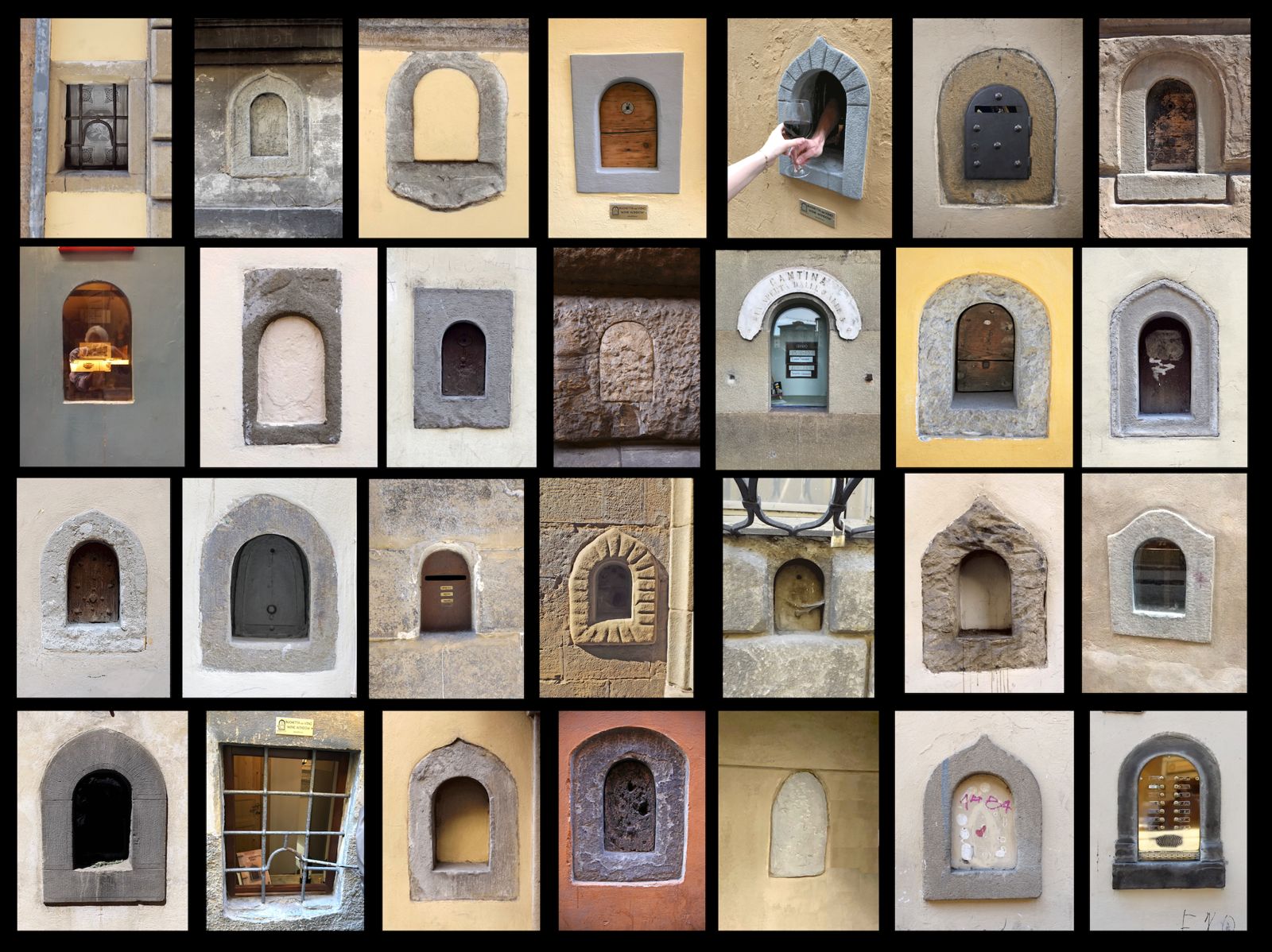
 With a few examples in the Langhe in Piemonte and in Faenza, a small city particularly famous for ceramics in Emilia-Romagna, “wine-windows” or buchette del vino are unique to Tuscany, especially to Florence. At first cut waist-high or at eye-level in the large wooden entrance doors and later in the facades of aristocratic palazzi, they’re roughly 12 inches tall and 8 inches wide, barely big enough for the street-side customer first to knock on the door, which always opened onto the inside, and pass a single flask to the factotum/cellar-man inside who filled it and passed it back. Nonetheless, for over 400 years—from the Renaissance until the last testimonial in 1958- these small hatches with a wooden or metal door and an arched or rectangular stone frame, have played an essential role the city’s daily life.
Ever since Stanley Tucci, actor, producer, director, and screenwriter, delighted American viewers with his 2021 CNN six-part Searching for Italy series, Florence’s buchette del vino have enjoyed a new renaissance. If you click on their internet entry, you’ll find numerous offers of walking tours to discover their history. These vary in length (from 1 to 2 hours) and vary in price depending on how many pitstops they make at the some 15 buchette that have reopened as bars or restaurants.
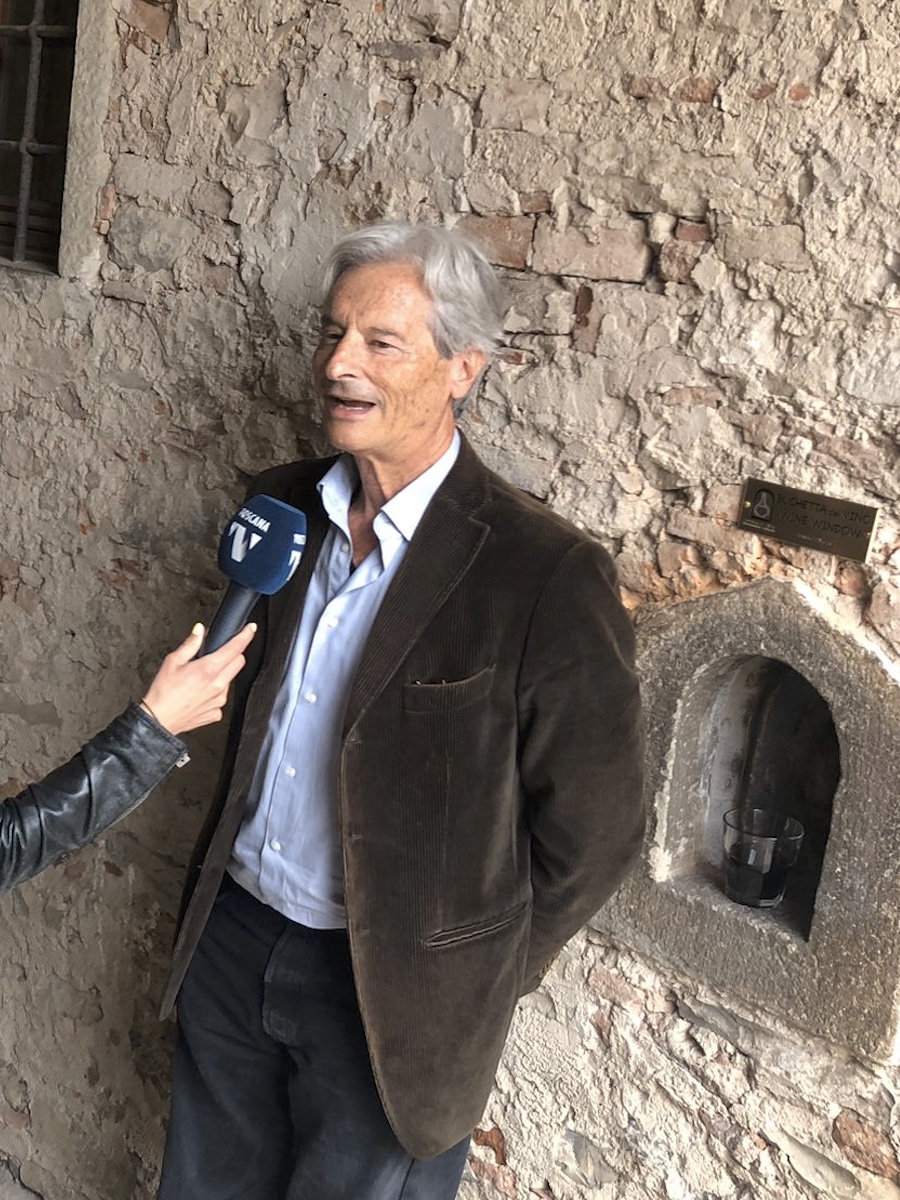
Matteo Faglia explaining a “wine-window”
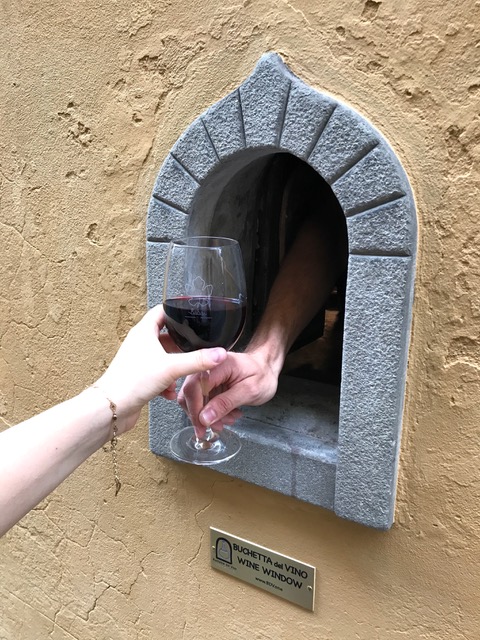
A “Wine-Window”
Instead, I chose a one-hour tour at 10 euros per person and no tasting included with Milan-born author and editor Matteo Faglia, who moved to Florence in 1972 where he founded the children’s book publishing house “Patatrac”, and was the editor-in-chief of the young people’s book section for the publishers Giunti and DeAgostini. He first lived in a palazzo near the Duomo at Via Borgo degli Albizi 26 (the Palazzo Ramirez Montalvo) with a “wine-window” which so sparked his interest that in 2015, with art historian and author Diletta Corsini and American ex-pat and long-term resident of Florence Mary Christine Forrest, he founded the Associazione Buchette del Vino, Via della Pergola 48, tel. 011-055-0503936, www.buchettedelvino.org, info@buchettedelvino.org. “Today,” he told me, “we have 110 members, 20 of whom are active. Besides giving guided tours, we organize exhibitions and conferences, as well as take photographs, do research in local archives and write books about the buchette. We’ve discovered some 400 buchette in Tuscany, although in the past we know there were many more, reaching their peak in the 1700s; some 200 in Florence are still visible; we’ve found archival evidence for another 120 in Florence, which are no longer visible because some were removed from their original locations or lost in building demolition; as well as another 120 in the rest of Tuscany, mainly in the cities of Lucca, Montepulciano, Pisa, San Gimigiano, and Siena.
In Florence the buchette are concentrated in the city center and in the oltrarno, across the Arno, in the San Frediano neighborhood. Most of them are defunct: plastered over, bricked up, or turned into mailboxes or doorbells. Individually made, no two are exactly alike. Some have been “decorated” by street artists; many lost their wooden doors in the 1966 flood.”
The first buchette date to the mid-16th century for in 1559, to gain popularity with the merchants and bankers of Florence who’d diversified their investments to include vineyards, Cosimo I de’ Medici, Grand Duke of Tuscany, allowed them to sell their surplus wine directly from their city residences. This allowed them to avoid middlemen, retail taxes, and contact with unwanted visitors in their elegant homes.

Cosimo I de’ Medici, painted by Agnolo Bronzino and in the Uffizi
The earliest document mentioning a buchetta, recently discovered in a local archive, dates to 1596. It details fees paid to a carpenter and blacksmith to install a wine window at the Palazzo Rucellai. The latest to be found was on July 30, 2020.
The buchette became iconic during the bubonic plague which ravaged Italian cities between 1629 and 1631 and killed at least 300,000 people. Verona was the hardest hit losing 60% of its population; Milan and Parma 50%, Venice 30%, while Florence, thanks to the buchette’s social distancing, lost 9,000 inhabitants out of 76,000 or 12%.

Francesco Rondinelli
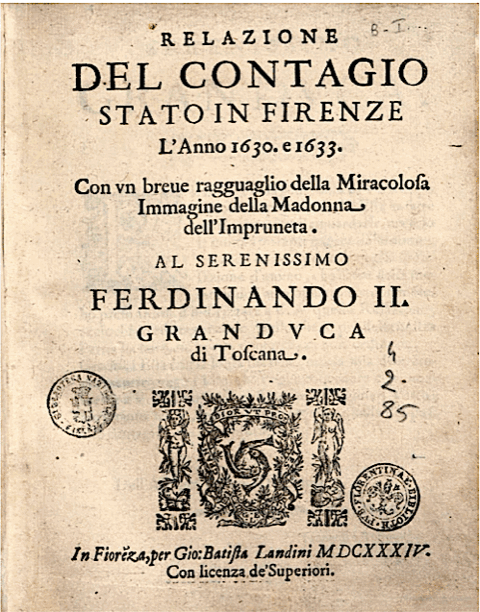
Rondinelli’s treatise
According to the Florentine scholar and academic Francesco Rondinelli in his Relazione di Contagio stato in Firenze l’anno 1630 e 1633 (1634) “those who sold wine from home, to escape any danger of catching the plague by touching the flasks, since the purchasers were mainly the poor, installed a tin spout at the hatch, with a funnel attached for pouring the wine, and whoever was buying it outside received it there.” To avoid infection, as an additional safety measure, the sellers collected the coins paid for the wine using a copper scoop, immediately throwing them in vinegar as a disinfectant.
In their book, Wine Windows in Florence and Tuscany, purchasable on Amazon for 12,90 euros, Diletta Corsini and Lucrezia Giordano tell us: Again for reasons of social distancing, “in May 2020, during the first COVID-19 lockdown…a number of long forgotten wine windows found a new lease on life”: the first to reopen were Bistrot Babae , Via Santo Spirito 21R, (in Latin, its name is an interjection used to express surprise, amazement, or wonder, best translated as “wow!” or “oh!) and Gelateria Vivoli, Via Isole delle Stinche 7R, (near the Basilica di Santa Croce, the largest Franciscan church in the world, which was founded around 1228); Ristorante Pietrabianca, Piazza dei Peruzzi 1, (also near Santa Croce); Il Latini, Via dei Palchetti 6R, (first opened in 1911 and now in its fourth generation of ownership by the Latini family); Osteria delle Brache, Piazza dei Peruzzi 5R; Cantina de’ Pucci, Via de’ Pucci 4, close to the Duomo); and Osteria delle Belle Donne, Via delle Belle Donne 16R, (beautifully decorated with flowers near the railroad station Santa Maria Novella); joined later by Fiaschetteria Fantappiè, Via dei Serragli 47R (a family-owned wineshop with snacks, opened in 1947, near Babae in the oltrarno); Osteria San Fiorenzo, Borgo dei Greci 1R near Vivoli; DiVin Boccone, Via delle Caldaie 30R (also in the oltrarno); Caffè Duomo (on the same square as the Duomo), and Cafè Odeon, Piazza degli Strozzi 2, (a Renaissance palace built in 1457, a cinema from 1922, and now an incredible bookstore with art exhibitions).